 |
| YOU ARE HERE : North India Travel Packages >North Indian Tourist Destinations > Leh Ladakh Tours Travel |
Leh Ladakh Tours Travel
Ladakh
Popularly known as "Hermit Kingdom", Ladakh is a land of snow carved peaks, translucent Lakes, barren terrain and mystic culture. The district of Ladakh lies at the border with Tibet at the most eastern corner of the State of Kashmir.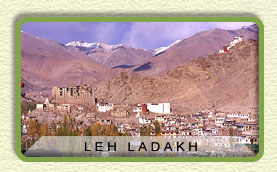 Bounded
by two of the world's mightiest mountain ranges, the Great Himalaya and
the Karakoram, Ladakh is a land like no other. Ladakh is often referred
to as the "Little Tibet", or the "Last Shangri-La".
Ladakh is the trans-Himalayan region, which separates the western
Himalayan peaks from the Tibetan plateau. In geological terms, this is a
young land, formed only a few million years ago by the buckling and
folding of the earth's crust as the Indian sub-continent pushed with
irresistible force against the immovable mass of Asia.
Bounded
by two of the world's mightiest mountain ranges, the Great Himalaya and
the Karakoram, Ladakh is a land like no other. Ladakh is often referred
to as the "Little Tibet", or the "Last Shangri-La".
Ladakh is the trans-Himalayan region, which separates the western
Himalayan peaks from the Tibetan plateau. In geological terms, this is a
young land, formed only a few million years ago by the buckling and
folding of the earth's crust as the Indian sub-continent pushed with
irresistible force against the immovable mass of Asia.
A thousand years ago before the contol of Tibets rule, Raja Skitde Nemagon, ruled over Ladakh which was known as Muryul (Red Country), as most of the mountains and the soil in Ladakh wears a red tinge. In the 10th Century A.D Skitday Nemagon, along with a couple of hundred men, invaded Ladakh where there was no central authority. The Land was divided in small principalities, which were at war with each other. Nemagon defeated all of them and established a strong central authority. Those days Shey, was the capital of Ladakh became to be known as Nariskorsoom, a country of three provinces. The present Ladakh was divided into two provinces while the third comprised western Tibet. The area of western Tibet slipped away from the kingdom but was reunited in 16th Century A.D. by the famous Ladakhi ruler Sengge Namgyal.
People and Culture
People of Ladakh are mostly Mahayana Buddhists belonging to the sect of the Red or Yellow Lamas. The faces and physique of the Ladakhis, and the clothes they wear, are more akin to those of Tibet and Central Asia than of India. Ancient inhabitants of Ladakh were Dards, and Indo-Aryan race from down the Indus. But immigration from Tibet more than a thousand years ago largly overwhelmed the culture of the Dards and moped up their racial characters. In eastern and central Ladakh, todays population seems to be mostly of Tibet origin. Further west, in and around Kargil, the people's appearance suggests a mixed origin.
How to reach
Leh
Leh is breathtaking. Towering over the city is the tall nine storeyed palace built by Ladakh’s ruler Sengge Namgyal in the early 17th century. It is said to have served as the model for the Potala palace in Lhasa. Another palace in Lhasa. Another palace built by King Tashi Namgyal in the 16th century stands above it on the Namgyal Tsemo peak. Down below, the town is a maze of little box like buildings bristling with brushwood stored on the roof for winter, set in an oasis of green fields.
Buddhism & Monasteries In Leh
 Though
Leh has been capital of this region since the 17th century, strewn
around it along the Indus valley are earlier capitals of he region. From
Leh one can wander off on marvellous day expeditions to get a glimpse of
some of the treasures of Ladakh. Not far from Leh, Shey is the oldest
capital of Ladakh from where its earliest Tibetan kings ruled. Perched
on top of a huge rock are the royal palace and temples adorned with
brilliantly coloured murals and a 7.5 metre gold statue of the Buddha.
Basgo and Tingmosgang with their forts and palaces were also capitals of
Ladakh. Stok Palace across the river from Leh is the home of the
erstwhile royal family. The Palace Museum here has collections of
beautiful royal costumes and jewellery, exquisite Thangkas, porcelain,
jade, weapons and armour. Within easy reach of Leh is the Spituk
Monastery with its commanding view of he indus. It has fine Thangkas and
a collection of ancient masks. Thikse Monastery one of the most
impressive in the area is spectacularly located and is noted for its
beautiful murals. Hemis is of course the biggest gompa in Ladakh and the
best known for its magnificent summer festival that celebrates the birth
anniversary of Guru Padmasambhava. The largest thangka in Ladakh is to
be found here. It is unfolded only once every 12 years.
Though
Leh has been capital of this region since the 17th century, strewn
around it along the Indus valley are earlier capitals of he region. From
Leh one can wander off on marvellous day expeditions to get a glimpse of
some of the treasures of Ladakh. Not far from Leh, Shey is the oldest
capital of Ladakh from where its earliest Tibetan kings ruled. Perched
on top of a huge rock are the royal palace and temples adorned with
brilliantly coloured murals and a 7.5 metre gold statue of the Buddha.
Basgo and Tingmosgang with their forts and palaces were also capitals of
Ladakh. Stok Palace across the river from Leh is the home of the
erstwhile royal family. The Palace Museum here has collections of
beautiful royal costumes and jewellery, exquisite Thangkas, porcelain,
jade, weapons and armour. Within easy reach of Leh is the Spituk
Monastery with its commanding view of he indus. It has fine Thangkas and
a collection of ancient masks. Thikse Monastery one of the most
impressive in the area is spectacularly located and is noted for its
beautiful murals. Hemis is of course the biggest gompa in Ladakh and the
best known for its magnificent summer festival that celebrates the birth
anniversary of Guru Padmasambhava. The largest thangka in Ladakh is to
be found here. It is unfolded only once every 12 years.
Trekking
Leh is a trekker's paradise. The treks from Spituk to the Markha valley and Lamayuru gompa to Chiling village alongside the Zanskar River are the most popular treks in the region. Another trek route is from Likir to Temisgam. Treks are open from the June end upto mid October. The passes for trekking are as high as 5,000 m in altitude. Many trekking agencies in Leh offer trek packages with a guide, packhorses, food and supplies.
Leh Palace
A building in the grand tradition of Tibetan architecture said to have inspired from the famous Potala in Lhasa, which was built half a century later. The palace was built in the 17th century and had nine storeys , but it is now dilapidated and deserted. It was the home of the royal family until they were exiled to Stok in the 1830s. Within the palace are Buddhist wall paintings, centuries old 'tankas' or painted scrolls and other artefacts. Above the palace, at the top of the Namgyal hill, is the Victory Tower, built to commemorate Ladakh's victory over the Balti Kashmir armies in the early 16th century. This palace built for King Singge Namgyal, now houses the Ladakhi branch of the Indian Government's archaeological conservation organisation.
How to reach
Popularly known as "Hermit Kingdom", Ladakh is a land of snow carved peaks, translucent Lakes, barren terrain and mystic culture. The district of Ladakh lies at the border with Tibet at the most eastern corner of the State of Kashmir.
Bounded
by two of the world's mightiest mountain ranges, the Great Himalaya and
the Karakoram, Ladakh is a land like no other. Ladakh is often referred
to as the "Little Tibet", or the "Last Shangri-La".
Ladakh is the trans-Himalayan region, which separates the western
Himalayan peaks from the Tibetan plateau. In geological terms, this is a
young land, formed only a few million years ago by the buckling and
folding of the earth's crust as the Indian sub-continent pushed with
irresistible force against the immovable mass of Asia.A thousand years ago before the contol of Tibets rule, Raja Skitde Nemagon, ruled over Ladakh which was known as Muryul (Red Country), as most of the mountains and the soil in Ladakh wears a red tinge. In the 10th Century A.D Skitday Nemagon, along with a couple of hundred men, invaded Ladakh where there was no central authority. The Land was divided in small principalities, which were at war with each other. Nemagon defeated all of them and established a strong central authority. Those days Shey, was the capital of Ladakh became to be known as Nariskorsoom, a country of three provinces. The present Ladakh was divided into two provinces while the third comprised western Tibet. The area of western Tibet slipped away from the kingdom but was reunited in 16th Century A.D. by the famous Ladakhi ruler Sengge Namgyal.
People and Culture
People of Ladakh are mostly Mahayana Buddhists belonging to the sect of the Red or Yellow Lamas. The faces and physique of the Ladakhis, and the clothes they wear, are more akin to those of Tibet and Central Asia than of India. Ancient inhabitants of Ladakh were Dards, and Indo-Aryan race from down the Indus. But immigration from Tibet more than a thousand years ago largly overwhelmed the culture of the Dards and moped up their racial characters. In eastern and central Ladakh, todays population seems to be mostly of Tibet origin. Further west, in and around Kargil, the people's appearance suggests a mixed origin.
How to reach
- Air
Leh, the capital, has one of the highest airport in the world. It's almost the only way to access the area from november onwards until may, as mountain passes are closed. Indian Airlines operates regular scheduled flights to Leh from Delhi Chandigarh, Jammu and Srinagar. Some private airlines are also planning to operate air services between Delhi and Leh in the near future. - Road
The main overland approach to Ladakh is from the Kashmir Valley via the 434 km Srinagar-Leh road which remains open for traffic from early June to November. The most dramatic part of this road journey is the ascent up the 11,500 feet/3,505 m high Zoji-la, the pass in the Great Himalayan Wall that serves as the gateway to Ladakh. Regular bus services are available between Srinagar and Leh on this route with an overnight halt at Kargil. Taxis (cars and jeeps) are also available at Srinagar for the journey. Groups can charter buses for Leh, Kargil or Padum (Zanskar) at Srinagar. Since 1989, the 473 km Manali-Leh road has been serving as the second land approach to Ladakh. Open for traffic from around mid-June to early October, this high road traverses the upland desert plateaux of Rupshu whose altitude ranges from 3,660m to 4,570m. A number of high passes fall in route among which the highest one, known Taglang-la, is the world's second highest motorable pass at an altitude 17,469 feet / 5,325 m. The bus journey between Leh and Manali takes about 19 hours or two days with an overnight halt camps at Serchu or Pang. Gypsy and jeep taxis are also available, both at Manali and Leh.
Leh
Leh is breathtaking. Towering over the city is the tall nine storeyed palace built by Ladakh’s ruler Sengge Namgyal in the early 17th century. It is said to have served as the model for the Potala palace in Lhasa. Another palace in Lhasa. Another palace built by King Tashi Namgyal in the 16th century stands above it on the Namgyal Tsemo peak. Down below, the town is a maze of little box like buildings bristling with brushwood stored on the roof for winter, set in an oasis of green fields.
Buddhism & Monasteries In Leh
Though
Leh has been capital of this region since the 17th century, strewn
around it along the Indus valley are earlier capitals of he region. From
Leh one can wander off on marvellous day expeditions to get a glimpse of
some of the treasures of Ladakh. Not far from Leh, Shey is the oldest
capital of Ladakh from where its earliest Tibetan kings ruled. Perched
on top of a huge rock are the royal palace and temples adorned with
brilliantly coloured murals and a 7.5 metre gold statue of the Buddha.
Basgo and Tingmosgang with their forts and palaces were also capitals of
Ladakh. Stok Palace across the river from Leh is the home of the
erstwhile royal family. The Palace Museum here has collections of
beautiful royal costumes and jewellery, exquisite Thangkas, porcelain,
jade, weapons and armour. Within easy reach of Leh is the Spituk
Monastery with its commanding view of he indus. It has fine Thangkas and
a collection of ancient masks. Thikse Monastery one of the most
impressive in the area is spectacularly located and is noted for its
beautiful murals. Hemis is of course the biggest gompa in Ladakh and the
best known for its magnificent summer festival that celebrates the birth
anniversary of Guru Padmasambhava. The largest thangka in Ladakh is to
be found here. It is unfolded only once every 12 years. Trekking
Leh is a trekker's paradise. The treks from Spituk to the Markha valley and Lamayuru gompa to Chiling village alongside the Zanskar River are the most popular treks in the region. Another trek route is from Likir to Temisgam. Treks are open from the June end upto mid October. The passes for trekking are as high as 5,000 m in altitude. Many trekking agencies in Leh offer trek packages with a guide, packhorses, food and supplies.
Leh Palace
A building in the grand tradition of Tibetan architecture said to have inspired from the famous Potala in Lhasa, which was built half a century later. The palace was built in the 17th century and had nine storeys , but it is now dilapidated and deserted. It was the home of the royal family until they were exiled to Stok in the 1830s. Within the palace are Buddhist wall paintings, centuries old 'tankas' or painted scrolls and other artefacts. Above the palace, at the top of the Namgyal hill, is the Victory Tower, built to commemorate Ladakh's victory over the Balti Kashmir armies in the early 16th century. This palace built for King Singge Namgyal, now houses the Ladakhi branch of the Indian Government's archaeological conservation organisation.
How to reach
- Air
Leh - Leh is the main airport for this area. Direct flights link it to Delhi, Chandigarh, Srinagar and Jammu. Kargil, Suru and Zanskar valleys - Srinagar and Leh airports are both convenient. - Road
Leh - Srinagar-Leh road is the main route with an over night halt at Kargil. The road is open between mid June and November. Ordinary and deluxe buses of the J&K state road transport corporation regularly ply on this route. Taxis can also be hired at Srinagar for this trip.
 |
| Recommended Tour Itineraries |
| -->
Golden
Triangle Tours with Kashmir Duration : 15 Days / 14 Nights Destination Covered : Delhi - Srinagar - Gulmarg - Kargil - Lamayuru - Leh - Agra - Fatehpur Sikri - Jaipur --> Rajasthan Forts & Palaces Tours Duration : 13 Days / 12 Nights Destination Covered : Delhi - Mandawa - Bikaner - Jaisalmer - Jodhpur - Mandore - Udaipur - Chittorgarh -Bundi - Kota - Jaipur - Delhi --> Rajasthan Camel Safari Duration : 15 Days / 14 Nights Destination Covered : Delhi - Mandawa - Bikaner - Jaisalmer - Jodhpur - Mt. Abu - Ranakpur - Udaipur - Kota - Ranthambore - Jaipur - Agra - Delhi |
| North Indian Tourist Destinations |
| Monuments in North India |
| Hill Stations in North India |
| Wildlife Attractions In Northern India |
| Guide to Forts & Palaces |
| Pilgrimage Destinations In Northern India |
