 |
| YOU ARE HERE : North India Travel Packages >North Indian Tourist Destinations > Gwalior Tours Travel |
Gwalior Tours Travel
Gwalior is named after a saint who cured the local chieftain Suraj Sen from leprosy. History of Gwalior dates back to 8th century. From then onwards Gwalior was to become the cradle of dynasties. The massive fort which overlooks the city 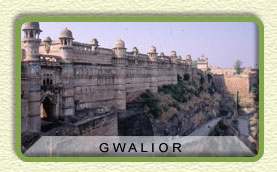 is a testimony to its glory and grandeur. Warrior kings, poets, musicians and saints contributed in making Gwalior the city it is.
Sightseeing / Attractions In Gwalior
Best Time To Visit Gwalior
Gwalior is heritage city of central India. More and more tourist attractions are there to visit to enjoy these attractions and historical sights best time is from September to April.
is a testimony to its glory and grandeur. Warrior kings, poets, musicians and saints contributed in making Gwalior the city it is.Sightseeing / Attractions In Gwalior
- Gwalior Fort
Built in the 15th century by Raja Mansingh Tomar on a hilltop, the mighty Gwalior Fort overlooks the city. The outer wall of the fort stands two miles in length and 35 m in height. - Gurudwara Data Bandhi Chhod
Built in the memory of Guru Hargobind Saheb, the 6th Sikh Guru who was imprisoned here by Emperor Jehangir for over two years. - Gujari Mahal
If Man Mandir reflects Man Singh's aesthetic sensibilities, Gujari Mahal speaks of his love. The courage and beauty of Mrignayani and her love with Raja Mansingh are now a part of popular folk tradition. The palace has been now converted in a museum and houses very good collection of Jain and Hindu artifacts. - Suraj Kund
Though major portions of the fort were built in the 15th century, references to this gigantic complex can be traced back to 425 A.D. Older than the city is the Suraj Kund within the fort walls, the original pond where Suraj Sen, or Suraj Pal as he was later known, was cured by saint Gwalipa. - Chanderi
Surrounded by forested hills and lakes, Chanderi is a craft centre, famous for its sarees and brocades. 239 km from Gwalior, Chanderi city has been influenced in its architecture by the Bundela Rajputs and the Sultans of Malwa. The Koshak Mahal, built on the orders of Mohammed Khiiji of Malwa in 1445 has an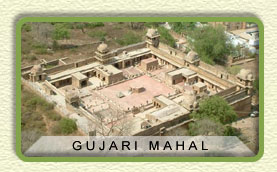 architectural style similar to that of Mandu. The Jama Masjid and Shahzadi Ka Rouza were also built by the Malwa Sultans, as was the Battisi Bandi built in 1485 by Sultan Ghyasuddin Shah. Northwest of Chanderi town is the pictureseque tank and temple complex of Parameshwar Tal, built by the Bundelas. The old city of Chanderi has Jain temples of the 9th and 10th centuries, and is an important pilgrim centre.
- Air
Gwalior is connected by Indian Airlines to Bombay, Bhopal, Indore, and Delhi. - Rail
Gwalior is on the main Delhi-Bombay and Delhi-Madras rail link. Among major trains, the Taj and Shatabdi Express connect Gwalior with Delhi and Agra. Gwalior is well linked with Agra (118 km), Mathura, Jaipur (350 km), Delhi (321 km), Lucknow, Bhopal (423 km), Chanderi (239 km), Indore (486 km), Jhansi (101 km), Khajuraho (275 km), Ujjain (455 km), and Shivpuri (114 km). - Road
The most common and cheapest way of moving around the city is the six-seater auto-rickshaws. Taxis are also available so are mini buses
Best Time To Visit Gwalior
Gwalior is heritage city of central India. More and more tourist attractions are there to visit to enjoy these attractions and historical sights best time is from September to April.
 |
| Recommended Tour Itineraries |
| -->
Delhi
Agra Jaipur Tours Duration : 7 Days / 6 Nights Destination Covered : Delhi - Agra - Jaipur - Delhi --> India Wildlife Tours Duration : 23 Days / 22 Nights Destination Covered : Delhi - Sariska - Jaipur - Ranthambore - Bharatpur - Agra - Khajuraho - Bandhavgarh - Kanha - Nagpur - Bhubaneshwar - Kokatta - Gauhati - Kaziranga - Delhi --> Royal Rajasthan Tour Duration : 13 Days / 12 Nights Destination Covered : Jaipur - Nawalgarh / Mandawa - Bikaner - Jaisalmer - Jodhpur - Udaipur - Jaipur - Agra - Delhi |
| North Indian Tourist Destinations |
| Monuments in North India |
| Hill Stations in North India |
| Wildlife Attractions In Northern India |
| Guide to Forts & Palaces |
| Pilgrimage Destinations In Northern India |
