 |
| YOU ARE HERE : North India Travel Packages >North Indian Tourist Destinations > Agra Tours Travel |
Agra Tours Travel
Agra is situated on the bank of Yamuna river, 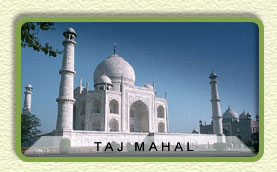 situated between 27°11' North latitude and 78°0' degree to 78°2' East longitude, at 169 meters above sea level. On the north it is bounded by Mathura, on the south by Dhaulpur, on the east by Firozabad, and on the west by Bharatpur. Travel to the great historical city of Agra and understand why Taj Mahal is considered as the "Love of a Man Epitomized in Stone". Travel to Agra and discover the fact that Agra is not only Taj Mahal but much more. The architectural splendor of the city is reflected in the glorious monuments of medieval India built by great Mughals who ruled India for more than 300 years. Travel to Agra and experience the the organized chaos that is India. India is best understood from the rampages of Agra Fort and nothing else.
The monument was commissioned in 1631 and took 20,000 artisans, 22 years to complete. An entire township now known as Taj Ganj came up around the site. Here, craftsmen live and sell their wares of marble and stone inlay and replicas of the Taj. After the reign of the last great Mughal, Aurangzeb, Agra fell into the hands of the Jats and then the Marathas. In 1803, the British under General Lake captured the city. Once again, it secured its position of eminence as the capital of the north-western provinces.
Climate / Best Time To Visit
In summer, between March and June, the temperature soars up to 45°C during the day. Dry, searing winds heat up the ground and make it difficult to venture outdoors. Light cottons are the best clothing, except in winter, when light woollens are required. The temperature is around 28°C during the day, but can go down to 4°C at night.
Agra Sightseeing
situated between 27°11' North latitude and 78°0' degree to 78°2' East longitude, at 169 meters above sea level. On the north it is bounded by Mathura, on the south by Dhaulpur, on the east by Firozabad, and on the west by Bharatpur. Travel to the great historical city of Agra and understand why Taj Mahal is considered as the "Love of a Man Epitomized in Stone". Travel to Agra and discover the fact that Agra is not only Taj Mahal but much more. The architectural splendor of the city is reflected in the glorious monuments of medieval India built by great Mughals who ruled India for more than 300 years. Travel to Agra and experience the the organized chaos that is India. India is best understood from the rampages of Agra Fort and nothing else.The monument was commissioned in 1631 and took 20,000 artisans, 22 years to complete. An entire township now known as Taj Ganj came up around the site. Here, craftsmen live and sell their wares of marble and stone inlay and replicas of the Taj. After the reign of the last great Mughal, Aurangzeb, Agra fell into the hands of the Jats and then the Marathas. In 1803, the British under General Lake captured the city. Once again, it secured its position of eminence as the capital of the north-western provinces.
Climate / Best Time To Visit
In summer, between March and June, the temperature soars up to 45°C during the day. Dry, searing winds heat up the ground and make it difficult to venture outdoors. Light cottons are the best clothing, except in winter, when light woollens are required. The temperature is around 28°C during the day, but can go down to 4°C at night.
Agra Sightseeing
- Taj Mahal
Situated on the banks of the River Yamuna, the Taj Mahal stands at the northern end of formal gardens. The white marble came from Makrana in Rajasthan and the red sandstone from Fatehpur Sikri. Precious stones like jade, crystal, turquoise, lapis lazuli, sapphire, jade, coral and diamonds were brought from far-flung places in Tibet, China, Sri Lanka, Persia and Afghanistan. It is believed that a fleet of 1000 elephants was used to transport the material. - Agra Fort
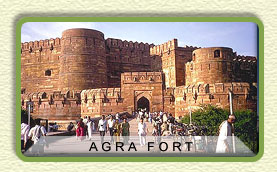 Agra's dominant structure and the World Heritage Site, the Agra Fort, also called the Red Fort, was rebuilt by Akbar in 1565. The red sandstone fort was renovated and converted into a palace during Shah Jahan's time, and reworked extensively with marble and pietra dura inlay. Notable buildings in the fort include the Pearl Mosque, the Diwan-e-Am and Diwan-e-Khas (halls of public and private audience), Jehangir's Palace, Khaas Mahal, Sheesh Mahal (mirrored palace), and Musamman Burj.
 - Itmad-Ud-Daulah's Tomb
Empress Nur Jehan built Itmad-Ud-Daulah's Tomb, sometimes called the Baby Taj, for her father, Ghias-ud-Din Beg, the Chief Minister of Emperor Jahangir. Small in comparison to many other Mughal-era tombs, it is sometimes described as a jewel box. Its garden layout and use of white marble, pietra dura, inlay designs and latticework presage many elements of the Taj Mahal.
- Air
Agraairport is about 7 kms. from the city center and 3 km from Idgah bus stand. Indian airlines operate daily tourist shuttle flights to Agra, Khajuraho, Varanasi and back. - Rail
Agra is well connected by railroad. The main railway station is the Agra Cantonment station. Trains like Palace on Wheel, Shatabdi, Rajdhani, and Taj Express are the best choices to reach Agra from Delhi.
 |
| Recommended Tour Itineraries |
| -->
Delhi Agra Jaipur Tours Duration : 7 Days / 6 Nights Destination Covered : Delhi - Agra - Jaipur - Delhi --> Golden Triangle Tours with Pushkar Duration : 11 Days/10 Nights Destination Covered : Delhi - Agra - Fatehpur Sikri - Jaipur - Pushkar - Ranakpur - Udaipur - Delhi --> Royal Rajasthan Tour Duration : 13 Days / 12 Nights Destination Covered : Jaipur - Nawalgarh / Mandawa - Bikaner - Jaisalmer - Jodhpur - Udaipur - Jaipur - Agra - Delhi |
| North Indian Tourist Destinations |
| Monuments in North India |
| Hill Stations in North India |
| Wildlife Attractions In Northern India |
| Guide to Forts & Palaces |
| Pilgrimage Destinations In Northern India |
